Some thoughts on purchasing OTTB’s, tire kickers, Karen’s, responsible ownership?
Responsible placement requires open communication. Resellers and aftercare organizations should be willing to answer questions and engage with potential adopters or buyers beyond the original listing. When inquiries about a Thoroughbred are met with silence or impatience, it doesn’t just frustrate me—it raises significant concerns. Thoughtful questions indicate a commitment to responsible ownership and ultimately protect the welfare of the horse.
I recognize that horses—both OTTBs and purpose-bred performance horses—often change hands throughout their lives. However, OTTBs, due to the nature of the racing industry and the retraining process that follows, tend to go through more transitions. While many of these moves are positive, increased transitions can lead to less long-term stability. Each new home introduces a level of uncertainty, making responsible placement, transparency, and informed ownership critical to ensuring these horses find safe and suitable environments.
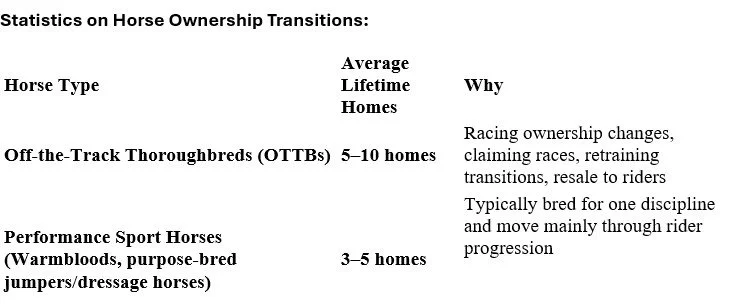
Statistics OTTB vs Performance Horses
Most Thoroughbreds will average 5–10 different owners or homes over their lifetime, which includes:
Most retired Thoroughbreds have 2–4 homes after racing.
Others, particularly those used for sport, may have 5 or more homes throughout their lives.
Approximate Breakdown (based on aftercare surveys):
~25–35% stay with their first post-track owner long-term
~40–50% change homes 2–3 times
~15–20% change homes 4+ times
While I used to aspire to be someone who trained and sold horses, I’ve realized that my perspective has shifted over the years after witnessing both wonderful outcomes and some truly heartbreaking ones. Unfortunately—or perhaps fortunately for the horses—I’ve turned out to be a bit of an epic failure in the resale industry.
The OTTBs I bring home now will stay here at Robyn’s Nest Farm. They deserve time to let down and simply be horses again before embarking on the slow, thoughtful journey of groundwork and training toward becoming finished products.
It may sound old-school, but I genuinely believe many horses today are being rushed through the process. The pressure to move them along quickly—train, sell, repeat—often leaves little room for the patience these horses truly need to transition from the racetrack to a new life.
Honestly, I could probably write an entire blog about this. The more I see, the more I feel that slowing down might be one of the best things we can do for these horses.
I have faith that most individuals working to broaden the horizons and opportunities for these incredible animals genuinely believe they’re adding value to owning a Thoroughbred—and indeed they are. But it raises an important question: why aren’t we also adding value to the process of bringing them home? The thoughtfulness of the purchase, the commitment to proper training, and long-term responsibility should matter just as much as the opportunities we hope to provide.
In conclusion, I may be one of those people some resellers or aftercare groups find annoying—the one who constantly asks questions and seeks more information. Recently, I’ve noticed that individuals like me are unfairly labeled as “Karens” or “tire kickers” for simply seeking clarity. This is not cool. Asking questions is not a problem; it’s a fundamental aspect of being a responsible horse person and safeguarding the horse’s future.